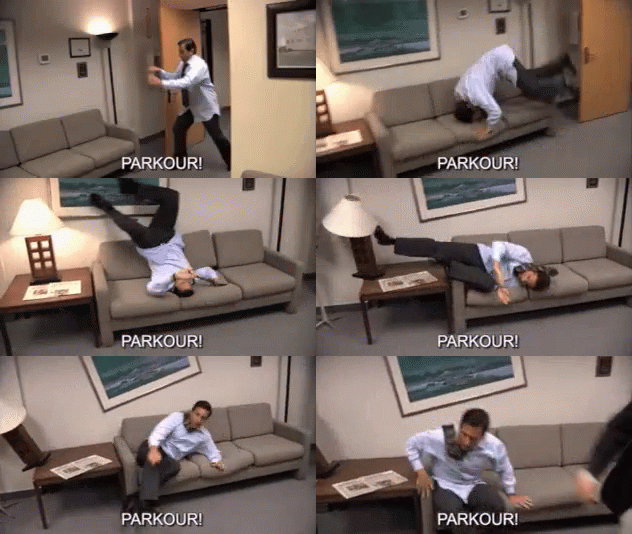
Most people go their entire lives never learning how to fall.
Everyone takes a tumble at some point.
Whether it’s a patch of ice, a trail root, a misstep off a curb, or just an unlucky moment, falls happen to all of us. And for a lot of people, especially as they age, a single fall can be genuinely life-altering. Hip fractures alone carry a staggering mortality rate in older adults. Roughly 20-30% don’t survive the following year, not from the fall itself, but from the cascade of complications that follow.
So today, I want to introduce you to something I think belongs in everyone’s physical toolkit: learning how to fall safely. Or at least, learning how to fall in a way that’s “less bad.” 😅
Let’s bring out your inner ninja.
The Skill Progressions
The goal of these progressions is simple: teach your body to round, absorb, and redirect force.
Start on a soft surface. Carpet is OK, but if you have access to Gymnastics mats or even a soft patch of grass outside (without any hidden rocks or sticks) that’s GREAT.
First rule of thumb: always start low to the ground. The closer you are to the ground when you begin the roll, the lower the forces involved.
You earn height gradually. Just like you learn to bench with the bar first before you add a kajillion pounds, you want to learn the technique before you add more height and intensity to your rolls!
PROGRESSION #1: The Egg Roll
Points of Performance
Keep the knees tucked tight to the chest to create a gentle curve through your low back
Slowly rock side to side
Transition as smoothly across your back as possible (it’s OK to let the leg open up to lead the way so you don’t get stuck!)
The goal here is just to get you comfortable on the ground in the safest way possible and start to feel what a “smooth transfer of force” feels like.
PROGRESSION #2: The Rocking Horse Roll
Points of Performance
Keep knees tightly tucked to chest to help maintain a gentle curve through your low back
Start in a seated position
Lean back and smoothly rock along your lower back, avoiding any “skipping” or “hitches” in the movement.
The rocks DON’T HAVE TO BE BIG. (If you feel like your “thunking” some part of your tail bone or back, you’re going too big for right now!)
Here, we learn to transfer momentum up and down the spine (rather than across it). This is our final step before we learn to transfer the force diagonally, which is actually the safest option in real world situations!
PROGRESSION #3: The Half Roll
Points of Performance
Start from a seated position
Lean towards one side, then roll from that hip towards the opposite shoulder (you want the contact to stop just below the shoulder blade)
Reach with your hands forming a triangle over that shoulder
Roll smoothly back to the starting position
This is where we really start to see the parkour roll come into shape. You can progress from seated to a standing position, but take your time! There’s no rush, and high quality reps is how we really learn this skill.
PROGRESSION #4: The Forward Roll
Points of Performance
Start from a kneeling position on a soft surface. Make sure to check the area so there’s nothing you will catch yourself on, and give yourself plenty of room.
Using the “triangle to back“ method, reach your hands forward and to the side to guide the back of your shoulder onto the ground, keeping your chin and head tucked down and to the side.
Kick over the top to complete the roll and exit on the opposite hip.
This movement can take some time to get comfortable with. If you feel stuck, go back and practice the earlier progressions again. Back to our bench press analogy, once you learn how to bench with heavier weight, you don’t SKIP doing lighter warm up sets!
Let’s be honest about the limits:
While learning and practicing these techniques will definitely make you safer and more resilient, it’s not a silver bullet.
Getting older makes it harder to react in time. Most dangerous falls are surprises, and your window to execute technique may be a fraction of a second or less. Sometimes, you won’t be able to execute a perfect forward roll. Reaction speed decreases with age, and flexibility factors in here as well.
This is also why bone density and muscle mass matter so much and why we sing the praises of strength training for people of all ages. Rolling technique and physical resilience aren’t either/or. They stack.
Eventually, we can start to practice rolling from different angles and different entry points so the skill can be applied more broadly, too.You won’t always have the perfect situation to roll in, but getting more comfortable with distributing force across the ground and protecting your head and neck is something that is still really helpful to learn.
When to practice
Rolling practice fits naturally into a dynamic warm-up, or it can be its own short session. One thing worth noting: learn this when you’re fresh, not at the end of a workout. You’re acquiring a motor skill, and fatigued nervous systems don’t learn well. Give it the attention it deserves. ❤️ This is one of those things that may take a few weeks or a few months of practice to get, but once you get it, it doesn’t take much to maintain it.
You got this. 💪
– Matt
P.S. Looking for practical, real-world advice without all the B.S.? That’s exactly what our coaching program is built on. 🔥
Leave a Reply